
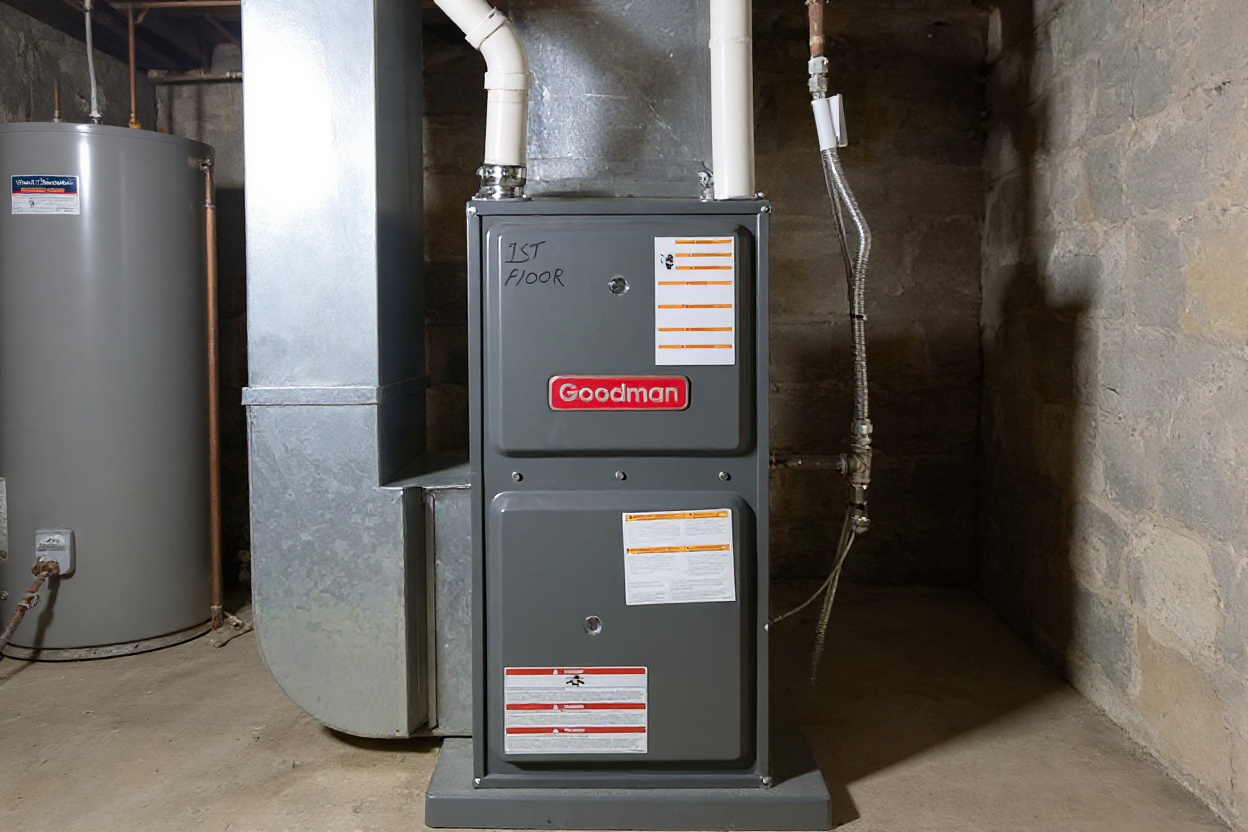
Most people never think about their furnace until it stops keeping the house warm. Then, all at once, the question is not just “what is wrong with it,” but “is this thing even worth fixing anymore?” A big part of that answer comes down to age. The same repair can be money well spent on a newer furnace and money wasted on one that is near the end of its life. So the first honest question to ask is: how old is my furnace, really? This guide walks you through how to find out, how long a furnace is supposed to last, and how to think clearly about the repair-versus-replace decision when it lands on you.
How to find out how old your furnace is
You do not need a technician to answer “how old is my furnace.” The information is almost always printed right on the unit, and finding it is a job you can safely do yourself. Everything here happens on the outside of the furnace. You never need to open the cabinet, and you should not.
Here is where to look:
- Find the rating plate. Every furnace has a metal or foil label, usually called the rating or data plate, stuck to the outside of the cabinet or on the inside of the front door where you can see it without taking anything apart. It lists the brand, the model number, and the serial number, and often quite a bit more.
- Look for a plain manufacture date first. On a lot of furnaces, the easiest win is right there on that plate. Many manufacturers print the manufacture date, or at least the year, in plain text. If you see something like “MFG DATE” or “DATE OF MFG” followed by a month and year, that is your answer and you are done.
- If there is no plain date, the serial number usually holds it. When the plate does not spell out a date, the manufacture date is very often hidden inside the serial number. Most brands encode the year, and sometimes the week or month it was built, into the first few characters of the serial. The catch is that the pattern is different from one brand to the next, so there is no single rule that reads every serial number.
- Decode it without guessing. Because the pattern varies by brand, the safest way to turn a serial number into a real date is to check with the manufacturer, look it up under your specific brand, or simply send us the brand, model, and serial and we will tell you what it means. It takes us a minute and saves you from guessing wrong on a decision this size.
- Check for other clues. If the plate is faded or missing, look for an install or service sticker from whoever put the system in, often stuck to the cabinet or the nearby ductwork with a date on it. Any permit paperwork from when the furnace was installed, or the home inspection report from when you bought the house, can also pin down the age.
A couple of common examples show what you are looking for in a serial number:
- Goodman, Amana, and Daikin furnaces usually put the date at the very start of the serial as the year and then the month. A serial that begins 1305 points to May 2013 (year 2013, month 05).
- Carrier, Bryant, and Payne usually start the serial with the week and the year. The first two digits are the week of the year and the next two are the year, so a serial that begins 4512 points to the 45th week of 2012.
- Other brands, including Trane, Lennox, and Rheem, use their own patterns, and a few tuck the year in as a letter instead of a number. If yours does not match the examples above, do not guess on a decision this size. Send us the brand, model, and serial and we will decode it for you.
A quick note on safety, because it matters more than the label. Reading the rating plate is a look-only job. Do not open the furnace cabinet, and do not touch the burners, the gas line, or any wiring to hunt for a number. If you ever smell gas, leave the house first and call your gas utility or 911 from a safe distance. The age of your furnace is never worth reaching past that line for.
How long does a furnace last?
Once you know the age, the next question is what to make of it. As a general rule of thumb, a gas furnace lasts somewhere in the range of 15 to 20 years. Some tired units give out earlier, and a well-built furnace that was installed correctly and maintained every year can push past 20. Treat that range as a guide, not a hard expiration date stamped on the machine.
A few things move a furnace toward the short end or the long end of that range:
- Maintenance. This is the big one. A furnace that gets a yearly tune-up, with a clean burner, good airflow, and a filter that actually gets changed, tends to last longer and run more safely than one that has never been looked at. A little upkeep genuinely buys you years.
- Install quality. A furnace that was correctly sized for the home and installed well starts life with an advantage. One that was oversized, undersized, or poorly vented tends to wear out faster.
- How hard it works. A furnace heating a drafty house through long Pittsburgh winters simply runs more hours than one in a tight, well-insulated home, and more run time means more wear.
- The filter habit. We keep coming back to filters because a clogged one makes the whole system strain, cycle harder, and age faster. It is the cheapest life-extender there is.
So if your furnace is only ten or twelve years old and it has been cared for, age alone is not a reason to replace it. If it is pushing 18 or 20 and starting to act up, age is very much part of the conversation. A yearly furnace tune-up is the simplest way to get the most life out of the furnace you have, and if you would rather not remember to book it every fall, our Maintenance Club puts that annual check on a schedule for you. No upsell, no pressure. It is just the easiest way to protect the equipment you already own.
When to replace a furnace: the honest signs
Knowing when to replace a furnace is really about weighing a few signs together, not reacting to any single one. A furnace that is a little older but running fine does not need replacing. A furnace that is old and showing several of the signs below is telling you something. Here is what we actually look at.
- Age near or past the range. A furnace in its late teens or older has less runway left, which changes the math on every repair. It does not mean replace today, but it means weigh repairs carefully rather than automatically fixing.
- Rising heating bills for no other reason. If your gas bills are creeping up winter over winter and your rates and habits have not changed, an aging furnace losing its efficiency is a common cause. You end up paying a little more every month to run a system that is wearing out.
- Repairs are getting more frequent or more expensive. One repair over many years is normal. Several repairs in a couple of seasons, or one big-ticket part after another, is a pattern. When a furnace starts nickel-and-diming you every winter, the repairs are often a sign the rest of the unit is not far behind.
- The house heats unevenly, or never quite gets comfortable. If some rooms stay cold, the furnace runs constantly, or it just cannot hold the temperature it used to, an older unit may be losing its capacity. Some of that is fixable, but on a furnace near the end of its life it can be a sign of decline.
If you are seeing one of these on an otherwise healthy, younger furnace, a furnace repair is very often the right call and the cheaper one. It is when several of these stack up on an aging unit that replacement moves to the front of the line.
The repair-versus-replace math, in plain terms
When a real repair bill lands on an older furnace, a lot of homeowners want a simple way to think about it. Here is the guideline the trade often uses, framed honestly: if a single repair costs more than about half the price of a new furnace, replacement usually makes more sense. Some people call it the 50 percent rule.
It is a starting point, not a law. Age belongs in the math right alongside the dollar figure. Spending a few hundred dollars on a furnace with a decade of life left is easy to justify. Spending that same amount on a 19-year-old unit that has needed two other repairs this winter is a different decision, even if the number is identical, because you may be buying only one more season before the next thing fails. The right move balances what the repair costs, how old the furnace is, and how it has been behaving.
Some of the biggest repair-or-replace decisions come from a problem you cannot spot yourself, one a technician finds and tells you about. The clearest example is a cracked or failed heat exchanger, the metal wall that separates the burning gas from the air your family breathes. If it cracks, it can leak carbon monoxide into the home, so it is a serious safety issue, and a technician will shut the furnace down rather than let it keep running that way. On an older furnace, replacing a heat exchanger is often so involved, in both parts and labor, that the repair costs nearly as much as a whole new system. When that is the situation, we will tell you plainly, so you can put the money toward the better long-term choice instead of a short-term patch.
We will always give you that math straight. If your furnace has another good winter or two in it, we will tell you that and fix what needs fixing. If you would genuinely be better off putting that repair money toward a replacement, we will show you why, lay out the options, and let you decide. There is no upsell in that conversation. We would rather keep a good furnace running than sell you one you do not need.
Not sure? That is exactly what we are here for
Working out how old your furnace is, and whether this is the year to replace it, is a lot easier with a second set of eyes on the actual equipment. If you have found the age and you are staring at a repair bill, or you just want an honest read on how much life your furnace has left, that is what we do.
Three Rivers Home Pros is right here in Greater Pittsburgh, and we would rather help you make a confident call than push you into a new system. Estimates and second opinions are free. Give us a call at (412) 285-1010 or request a free estimate, and we will look at your furnace, walk you through the repair-versus-replace math for your home, and answer every question you have about your home heating. We are registered and insured, we tell you what the job is before we start it, and we keep it fast, fair, and friendly, the way it should be.
Leave a Reply